Cleanroom Construction Cost in India 2026: Budget Guide by ISO Class
Plan your cleanroom project with accurate 2026 cost data. Covers per sq ft pricing for ISO 5 through ISO 8, detailed component breakdown including panels, HVAC, flooring, and doors, plus pharma vs electronics cost comparison.
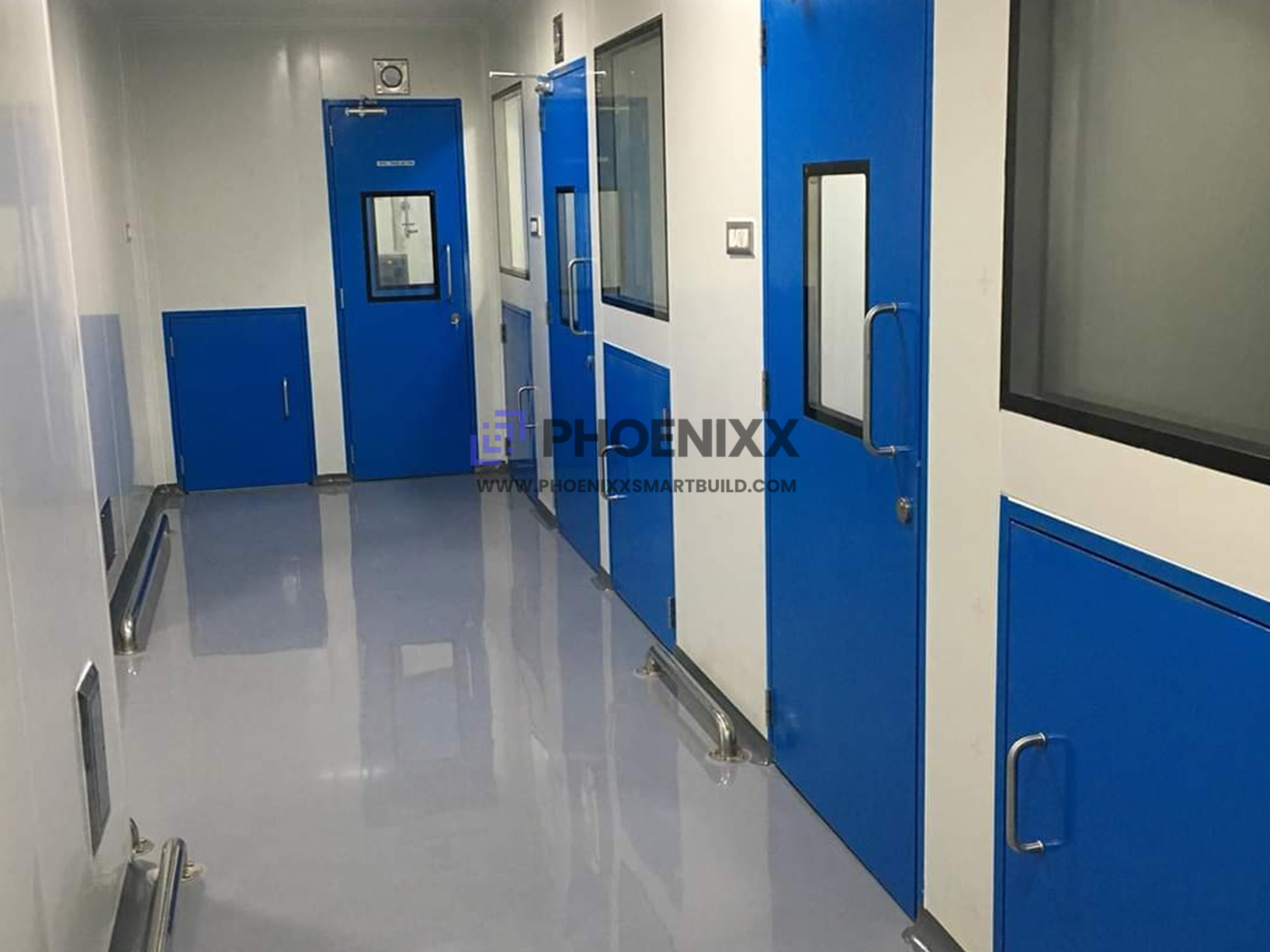
Cleanroom Construction: Why Costs Vary So Dramatically
Cleanroom construction in India is a specialised domain where costs can range from ₹3,500 to ₹25,000+ per sq ft depending on the classification level, industry, and compliance requirements. Unlike standard industrial construction, cleanrooms demand precise control of particulate contamination, temperature, humidity, and air pressure—all of which add complexity and cost to the project.
Whether you’re building a pharmaceutical manufacturing cleanroom, an electronics assembly environment, or a food processing area, understanding the true cost drivers will help you budget accurately and avoid expensive surprises. This guide breaks down 2026 cleanroom construction costs across ISO classifications and industry applications.
Cleanroom Cost Per Sq Ft by ISO Classification (2026)
The ISO 14644-1 classification determines the maximum allowable particle count in the cleanroom, which directly drives the cost of HVAC systems, filtration, and construction materials. Here are the current 2026 costs for turnkey cleanroom construction in India:
| ISO Class | Particles (≥0.5µm) per m³ | Air Changes/Hour | Cost per Sq Ft (₹) | Typical Applications |
|---|---|---|---|---|
| ISO 8 (Class 100,000) | 3,520,000 | 20–30 | ₹3,500 – ₹6,000 | General pharma, food packaging |
| ISO 7 (Class 10,000) | 352,000 | 30–60 | ₹6,000 – ₹10,000 | Tablet/capsule manufacturing, electronics assembly |
| ISO 6 (Class 1,000) | 35,200 | 60–120 | ₹10,000 – ₹16,000 | Injectable pharma, semiconductor packaging |
| ISO 5 (Class 100) | 3,520 | 200–600 | ₹16,000 – ₹25,000+ | Sterile filling, wafer fabrication |
The exponential increase in cost from ISO 8 to ISO 5 is driven primarily by HVAC requirements. An ISO 5 cleanroom needs 10–20 times more air changes per hour than an ISO 8, requiring significantly larger air handling units, more HEPA filters, and substantially higher energy consumption.
Component-Wise Cost Breakdown
For a typical 5,000 sq ft ISO 7 cleanroom (the most common classification for Indian pharmaceutical facilities), here’s how the budget distributes across components:
| Component | Cost (₹ Lakh) | % of Total |
|---|---|---|
| HVAC System (AHU, ducting, HEPA filters) | 90–130 | 30–35% |
| PUF panels for cleanrooms (wall & ceiling) | 55–80 | 18–22% |
| Flooring (epoxy/PU/vinyl) | 30–45 | 10–12% |
| Cleanroom partitions & pass boxes | 20–35 | 7–9% |
| Doors (airlock, interlocking, automatic) | 15–25 | 5–7% |
| Electrical & Lighting (LED clean fixtures) | 20–30 | 6–8% |
| BMS & Environmental Monitoring | 12–20 | 4–6% |
| Fire Detection & Suppression | 8–15 | 3–4% |
| Validation & Documentation (IQ/OQ/PQ) | 10–18 | 3–5% |
| Design, PMC & Contingency | 15–25 | 5–7% |
| Total (5,000 sq ft ISO 7) | 2.75–4.25 Crore | 100% |
HVAC is consistently the single largest cost component, accounting for roughly one-third of the total budget. The second-largest component is the cleanroom envelope: the cleanroom panel system that creates the sealed, controlled environment.
Panel Selection for Cleanrooms
The cleanroom envelope must be smooth, non-porous, non-shedding, and easy to clean. PHOENIXX SmartBuild offers specialised cleanroom panels with:
- Flush-joint design: Minimises ledges where particles can accumulate
- GPSP or SS facings: Galvanised pre-painted steel or stainless steel for pharma-grade surfaces
- Cam-lock jointing: Ensures airtight panel connections for pressure integrity
- Integrated service panels: Factory-fitted with electrical conduits and gas line provisions
Pharma Cleanroom vs Electronics Cleanroom: Cost Comparison
While both industries use cleanrooms, the cost structures differ significantly due to regulatory and operational requirements:
| Parameter | Pharmaceutical Cleanroom | Electronics Cleanroom |
|---|---|---|
| Typical ISO Class | ISO 7–ISO 5 | ISO 6–ISO 4 |
| Cost per Sq Ft | ₹6,000 – ₹20,000 | ₹10,000 – ₹30,000+ |
| Regulatory Compliance | WHO-GMP, Schedule M, USFDA | ISO 14644, ESD standards |
| Humidity Control | 45–65% RH | 30–50% RH (tighter control) |
| Temperature Tolerance | ±2°C | ±0.5–1°C |
| Gowning Requirements | Moderate (2–3 stage) | Extensive (3–4 stage + bunny suits) |
| Validation Requirements | Extensive (IQ/OQ/PQ mandatory) | Moderate (performance-based) |
| ESD Flooring | Not required | Mandatory (₹400–800/sq ft premium) |
Electronics cleanrooms are typically 30–50% more expensive than equivalent pharmaceutical cleanrooms due to tighter environmental tolerances and the need for ESD (Electrostatic Discharge) protection throughout the facility.
Cost Reduction Strategies for Cleanroom Projects
Smart design and planning can reduce cleanroom construction costs by 15–25% without compromising compliance:
- Right-size the classification: Only the critical process zone needs the highest ISO class. Use cascading classifications (ISO 5 within ISO 7) to reduce the high-grade area.
- Modular construction: Factory-built cleanroom partitions and pre-assembled panels reduce on-site labour and construction time by 30–40%.
- Energy-efficient HVAC: Variable-frequency drives (VFDs) on AHUs and EC fans reduce energy costs by 25–35% over the facility lifetime.
- Integrated design: Having a single provider handle panels, doors, partitions, and false ceiling eliminates coordination gaps and reduces overall cost.
- Future-proofing: Design HVAC and electrical infrastructure for potential upgrades. It’s far cheaper to install larger ducts initially than to retrofit later.
PHOENIXX SmartBuild: Turnkey Cleanroom Construction
PHOENIXX SmartBuild offers end-to-end turnkey cleanroom construction services, covering every aspect from initial design to validation handover. Our integrated approach delivers significant advantages:
- Single-source responsibility: Panels, doors, partitions, false ceilings, and pass boxes—all manufactured in-house
- Faster timelines: Modular construction reduces on-site work by 40%
- WHO-GMP compliance expertise: Our design team has delivered 200+ pharma cleanroom projects
- Competitive bundled pricing: Package deals on panels + doors + partitions save 10–15% vs separate procurement
- Post-installation support: Validation assistance, AMC, and filter replacement programmes
Planning a cleanroom project? Request a cleanroom quote with detailed specifications and budget estimation from PHOENIXX SmartBuild.
Frequently Asked Questions
What is the cost of cleanroom construction per sq ft in India in 2026?
Cleanroom construction cost in India ranges from ₹3,500/sq ft for ISO 8 (basic cleanroom) to ₹25,000+/sq ft for ISO 5 (sterile manufacturing). The most common ISO 7 pharmaceutical cleanroom costs ₹6,000–10,000/sq ft including HVAC, panels, flooring, and all MEP systems.
What is the biggest cost component in cleanroom construction?
HVAC (Heating, Ventilation, and Air Conditioning) is the largest cost component, accounting for 30–35% of total cleanroom construction cost. This includes air handling units, HEPA filters, ducting, and the control system. Higher ISO classifications require more air changes per hour, driving up HVAC costs significantly.
How much does a 5,000 sq ft pharma cleanroom cost in India?
A 5,000 sq ft ISO 7 pharmaceutical cleanroom in India costs approximately ₹2.75–4.25 crore in 2026. This includes HVAC, cleanroom panels, flooring, doors, electrical systems, BMS, fire safety, and validation. Costs can be lower for ISO 8 (₹1.75–3 crore) or higher for ISO 6 (₹5–8 crore).
How long does it take to build a cleanroom in India?
A modular cleanroom using pre-fabricated panels takes 60–90 days for a 5,000 sq ft facility. Traditional brick-and-mortar cleanroom construction takes 4–6 months for the same area. Larger facilities (10,000+ sq ft) or higher classifications (ISO 5–6) may take 90–150 days with modular construction.
Is modular cleanroom construction cheaper than conventional?
Yes, modular cleanroom construction using pre-fabricated panels is typically 15–20% cheaper than conventional construction when factoring in faster timelines, reduced on-site labour, and lower error rates. Modular cleanrooms also offer the advantage of being relocatable and expandable, adding long-term value.
Related Resources
Explore related products, locations, case studies, and technical guides from PHOENIXX SMARTBUILD.