How to Build a Cleanroom in India – Step by Step Guide
A comprehensive step-by-step guide to building an ISO-classified cleanroom in India. Covers cleanroom classifications, panel and flooring selection, HVAC system design, GMP compliance, validation, and cost overview.
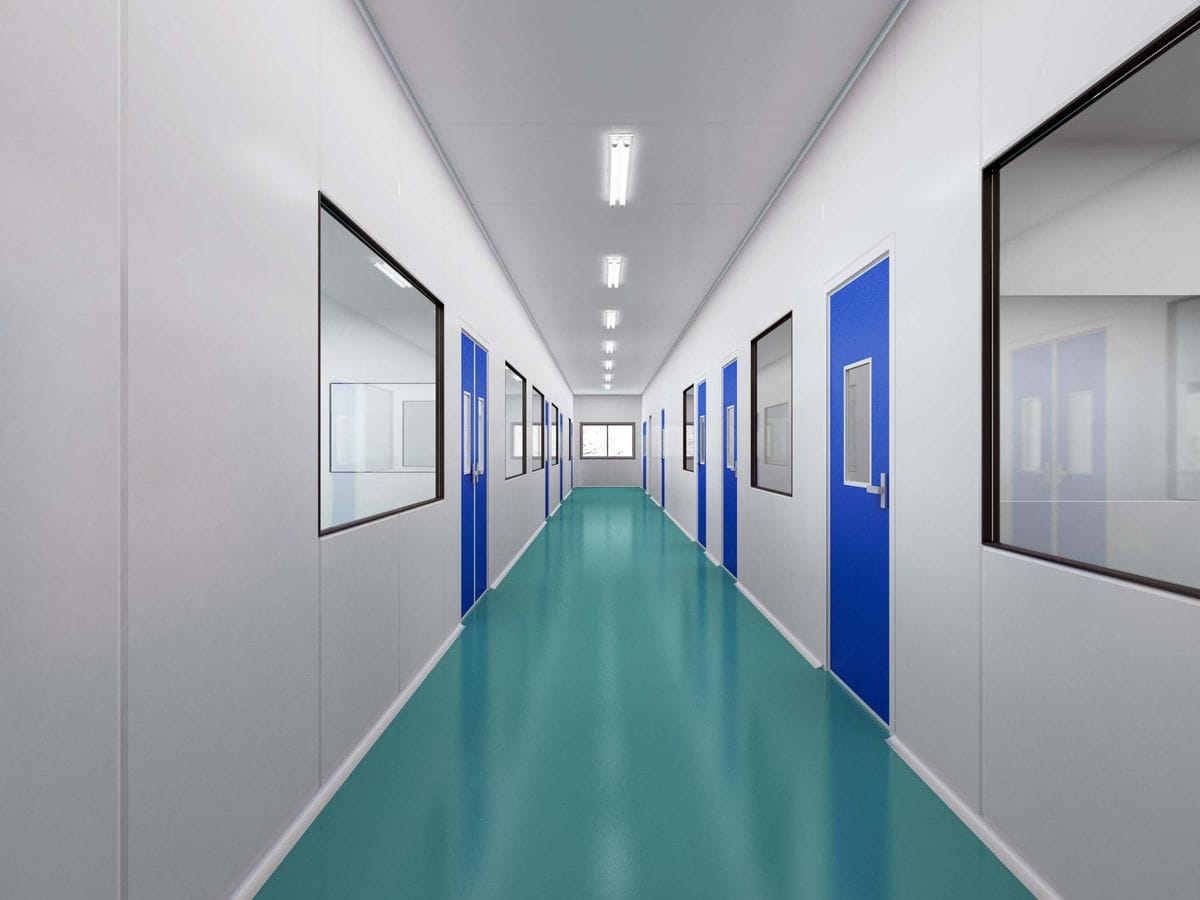
How to Build a Cleanroom in India – Step by Step Guide
Cleanrooms are controlled environments where airborne particles, temperature, humidity, and pressure are maintained within strict limits. They are essential for industries like pharmaceuticals, semiconductors, biotechnology, medical devices, food processing, and precision manufacturing.
Building a cleanroom in India involves careful planning, specialised materials, and strict adherence to standards. This guide walks you through the complete process of cleanroom construction in India, from design to validation.
Understanding Cleanroom Classifications
Cleanrooms are classified based on the maximum number of particles per cubic metre of air. The most widely used standard is ISO 14644-1:
| ISO Class | Max Particles ≥0.5µm per m³ | Air Changes/Hour | Typical Application |
|---|---|---|---|
| ISO 5 (Class 100) | 3,520 | 240–600 | Semiconductor fab, sterile drug manufacturing |
| ISO 6 (Class 1,000) | 35,200 | 90–240 | Optical lens, injectable drugs |
| ISO 7 (Class 10,000) | 352,000 | 30–90 | Pharma packaging, medical devices |
| ISO 8 (Class 100,000) | 3,520,000 | 10–30 | Food processing, general pharma, cosmetics |
The ISO classification you need determines everything – from HVAC sizing to panel specifications to operational costs. Getting this right at the planning stage is critical.
Step 1: Define Requirements and Scope
Before any construction begins, clearly document:
- ISO class required for each zone (production, packaging, corridors, gowning rooms)
- Temperature and humidity range (typically 20–25°C and 30–60% RH for pharma)
- Pressure differentials between zones (positive pressure for sterile manufacturing, negative for containment)
- Process-specific requirements (chemical resistance, anti-static properties, vibration control)
- Regulatory framework (WHO-GMP, EU-GMP, Schedule M, US FDA 21 CFR)
- Footprint and layout with personnel and material flow patterns
Step 2: Design the Layout
Cleanroom layout design must follow contamination control principles:
- Uni-directional flow: Personnel and materials should move from less clean to more clean zones through airlocks and pass boxes.
- Gowning rooms: Staged gowning sequence (street clothes → first change → second change) for higher ISO classes.
- Material airlocks: Separate pass-through for raw materials and finished goods to prevent cross-contamination.
- Return air paths: Low-level wall returns or raised floor plenums for proper air circulation.
- Utility corridors: Separate technical corridors for maintenance access without entering the cleanroom.
Work with a qualified cleanroom consultant who understands both the regulatory requirements and practical construction aspects. Visit our cleanroom solutions page for design consultation.
Step 3: Select Cleanroom Panels
Cleanroom wall and ceiling panels are the building blocks of the controlled environment. Key requirements:
- Flush, smooth surfaces: No crevices or joints where particles can accumulate. Panels must have concealed joints with silicone-sealed flush finishes.
- Non-shedding: Panel facings must not release particles. Use PPGI, PPGL, or stainless steel facings depending on the application.
- Easy to clean: Surfaces must withstand frequent cleaning with disinfectants (IPA, hydrogen peroxide, sodium hypochlorite).
- Fire rating: PIR-core panels are recommended for cleanrooms due to their B-s1, d0 fire classification.
- Panel thickness: 50–100 mm depending on insulation and structural requirements.
PHOENIXX SmartBuild’s cleanroom panels are specifically designed for pharmaceutical and electronics cleanrooms, with flush cam-lock joints and food-grade coatings.
For partitioning within the cleanroom, cleanroom partition systems provide modular flexibility for future reconfiguration.
Step 4: Floor System
Cleanroom flooring must be seamless, chemical-resistant, and non-particle-generating:
- Epoxy flooring: Most common for ISO 7–8 cleanrooms. Self-levelling epoxy (2–3 mm thick) with integral coving at wall junctions. Cost: ₹150–300 per sq ft.
- PU (Polyurethane) flooring: Better chemical resistance than epoxy. Preferred for pharma production areas. Cost: ₹250–400 per sq ft.
- Vinyl sheet flooring: Used for ISO 5–6 cleanrooms. Welded vinyl sheets with zero joints. Cost: ₹200–350 per sq ft.
- Raised access flooring: Used when underfloor return air plenum is required (semiconductor fabs). Cost: ₹400–700 per sq ft.
Step 5: HVAC System Design
The HVAC (Heating, Ventilation, and Air Conditioning) system is the heart of any cleanroom, typically accounting for 35–45% of the total project cost:
- AHU (Air Handling Unit): Sized based on the required air changes per hour. An ISO 7 cleanroom typically needs 30–60 ACH, while ISO 5 may need 240–600 ACH.
- HEPA filters: H13 or H14 HEPA filters (99.97–99.99% efficiency at 0.3µm) installed in the ceiling as terminal filter modules.
- ULPA filters: For ISO 5 and above, ULPA filters (99.9995% at 0.12µm) may be required.
- Pre-filters and secondary filters: Protect the HEPA filters from premature clogging and extend their life to 3–5 years.
- Ductwork: GI ducts with internal insulation, designed for low air velocity to minimise noise and vibration.
- Controls: BMS (Building Management System) integration for automated temperature, humidity, and pressure control with data logging.
Step 6: Electrical and Lighting
Cleanroom electrical systems must be designed for reliability and cleanliness:
- Lighting: LED teardrop-style or recessed panel lights rated for cleanroom use. Illumination: 300–500 lux for general areas, 500–750 lux for inspection areas.
- Power outlets: Flush-mounted, sealed outlets to prevent particle harbouring.
- Emergency power: UPS for critical systems and DG backup for 100% HVAC load.
- Earthing: Anti-static earthing for electronics cleanrooms per IS 3043.
Step 7: GMP Compliance and Documentation
For pharmaceutical cleanrooms in India, compliance with Schedule M (revised) and WHO-GMP guidelines is mandatory:
- Design Qualification (DQ): Verify that the design meets all regulatory requirements
- Installation Qualification (IQ): Verify that equipment is installed per manufacturer specifications
- Operational Qualification (OQ): Verify that systems operate within specified parameters
- Performance Qualification (PQ): Verify that the cleanroom performs consistently under production conditions
All qualification activities must be documented with protocols, test results, and deviation reports.
Step 8: Validation and Testing
Before the cleanroom becomes operational, conduct these critical tests per ISO 14644-3:
- Airborne particle count: At-rest and in-operation particle counts at specified sampling locations
- Air velocity and uniformity test: Measure air velocity across HEPA filter faces (0.36–0.54 m/s for laminar flow)
- HEPA filter integrity test: DOP or PAO aerosol challenge test to verify zero leaks
- Pressure differential test: Verify cascade pressurisation between zones (10–15 Pa between adjacent zones)
- Temperature and humidity mapping: Multi-point monitoring over 24–72 hours
- Recovery test: Measure time to recover from a contamination event
- Microbial monitoring: Surface and air sampling for bioburden (pharma cleanrooms)
Cost Overview for Cleanroom Construction in India
| ISO Class | Cost per sq ft (₹) | Major Cost Driver |
|---|---|---|
| ISO 8 | ₹3,000–₹5,000 | Panels, basic HVAC |
| ISO 7 | ₹5,000–₹8,000 | HVAC, HEPA filters |
| ISO 6 | ₹8,000–₹14,000 | Higher ACH, more HEPA coverage |
| ISO 5 | ₹14,000–₹25,000 | Full HEPA ceiling, ULPA, unidirectional flow |
For a detailed breakdown, read our cleanroom construction cost in India guide.
Conclusion
Building a cleanroom in India requires specialised knowledge, quality materials, and close attention to detail. From panel selection to HVAC design to GMP validation, every element must work in harmony to achieve the required cleanliness classification.
PHOENIXX SmartBuild offers comprehensive cleanroom solutions including design consultation, cleanroom panels, partition systems, and project management. Contact us for a free consultation tailored to your industry and ISO classification requirements.
Frequently Asked Questions
How much does it cost to build a cleanroom in India?
Cleanroom construction costs in India range from ₹3,000 per sq ft for ISO 8 to ₹25,000 per sq ft for ISO 5. A typical 2,000 sq ft ISO 7 pharmaceutical cleanroom costs ₹1–1.6 crore including panels, HVAC, flooring, electrical, and validation. The HVAC system alone accounts for 35–45% of the total cost.
Which panels are best for cleanroom construction?
PIR (Polyisocyanurate) core sandwich panels with flush cam-lock joints are the best choice for cleanrooms. They offer excellent fire performance (B-s1, d0), smooth non-particle-shedding surfaces, and good insulation. For pharma cleanrooms, stainless steel or PPGI facings with food-grade coatings are recommended.
What is the difference between ISO 7 and ISO 8 cleanrooms?
ISO 7 allows a maximum of 352,000 particles (≥0.5µm) per cubic metre and requires 30–90 air changes per hour. ISO 8 allows 3,520,000 particles per cubic metre and needs only 10–30 air changes per hour. ISO 7 is used for injectable drugs and medical devices, while ISO 8 is sufficient for oral dosage forms, food processing, and cosmetics.
How long does it take to build a cleanroom in India?
A typical cleanroom project takes 8–16 weeks from start to validation. This includes 2–3 weeks for panel installation, 3–4 weeks for HVAC installation, 1–2 weeks for flooring and electrical, and 2–4 weeks for IQ/OQ/PQ validation. Modular panel-based cleanrooms are significantly faster than conventional drywall construction.
Do I need a consultant to build a cleanroom?
Yes, it is highly recommended to engage a qualified cleanroom consultant, especially for pharmaceutical cleanrooms where GMP compliance is mandatory. A consultant handles regulatory requirements, HVAC sizing calculations, contamination control strategy, and validation protocols. The consultant’s fee (typically 5–10% of project cost) is a worthwhile investment to avoid costly errors and regulatory non-compliance.
Related Resources
Explore related products, locations, case studies, and technical guides from PHOENIXX SMARTBUILD.