Types of Sandwich Panels Explained – PUF, PIR, Rockwool & More
A comprehensive comparison of sandwich panel types—PUF, PIR, Rockwool, EPS, and XPS—covering their properties, advantages, limitations, applications, and price ranges to help you select the right panel.
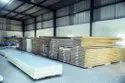
What Are Sandwich Panels?
Sandwich panels (also called insulated panels or composite panels) are prefabricated building elements consisting of an insulating core material bonded between two metal face sheets. They are used for walls, roofs, ceilings, and partitions in industrial, commercial, and cold chain construction. The term “sandwich” refers to the layered structure—much like a sandwich with bread on both sides and filling in the middle.
Choosing the right type of sandwich panel depends on your project’s requirements for thermal insulation, fire resistance, acoustic performance, budget, and compliance standards. In this guide, we cover the five most common types of sandwich panels available in India and help you make an informed decision.
1. PUF (Polyurethane Foam) Sandwich Panels
Overview
PUF sandwich panels feature a rigid polyurethane foam core with a thermal conductivity of 0.020–0.024 W/mK: the lowest among common insulation materials. This makes them the most thermally efficient option per unit thickness.
Properties
- Thermal conductivity: 0.020–0.024 W/mK
- Density: 38–45 kg/m³
- Fire rating: B2 (self-extinguishing), upgradable to B1 with additives
- Temperature range: −40°C to +80°C
Best For
Cold storage, industrial roofing and cladding, warehouses, clean rooms, poultry sheds, and any application where maximum insulation with minimum thickness is needed.
Price Range
₹100–₹400 per sq ft depending on thickness (30–150 mm) and steel specification.
2. PIR (Polyisocyanurate) Sandwich Panels
Overview
PIR panels are the fire-safe evolution of PUF panels. The polyisocyanurate chemistry produces a foam that chars rather than burns, dramatically reducing flame spread and smoke generation.
Properties
- Thermal conductivity: 0.020–0.023 W/mK
- Density: 40–48 kg/m³
- Fire rating: Bs1d0 (EN 13501-1), FM 4880/4881 eligible
- Temperature range: −40°C to +120°C
Best For
Cold storage with insurance requirements, pharmaceutical facilities, food processing plants, data centres, and any project requiring FM approval or enhanced fire safety.
Price Range
₹120–₹480 per sq ft—roughly 10–20% above equivalent PUF panels.
3. Rockwool (Mineral Wool) Sandwich Panels
Overview
Rockwool sandwich panels use a core of mineral wool (stone wool) fibres derived from volcanic basalt rock. Their standout feature is non-combustibility—rockwool does not burn, smoke, or produce toxic fumes, earning an A1/A2 fire classification.
Properties
- Thermal conductivity: 0.034–0.040 W/mK
- Density: 100–150 kg/m³
- Fire rating: A1/A2 (non-combustible) per EN 13501-1
- Temperature range: −40°C to +750°C (core material)
- Acoustic insulation: Excellent (Rw up to 35 dB for 50 mm panels)
Best For
Fire-critical applications (fire walls, escape corridors), acoustic barriers, high-temperature environments, buildings in high-density urban areas subject to strict fire codes.
Price Range
₹130–₹350 per sq ft. The higher density makes rockwool panels heavier, potentially increasing structural steel costs.
4. EPS (Expanded Polystyrene) Sandwich Panels
Overview
EPS panels use expanded polystyrene (thermocol) as the core material. They are the most economical sandwich panel option and are widely used where basic insulation is needed without stringent fire or temperature requirements.
Properties
- Thermal conductivity: 0.035–0.040 W/mK
- Density: 15–25 kg/m³
- Fire rating: B3 (flammable); can be improved to B2 with flame-retardant grades
- Temperature range: −10°C to +75°C
Best For
Non-critical partitions, temporary structures, site offices, and budget-sensitive projects where fire safety is managed through other means (sprinklers, fire barriers).
Price Range
₹60–₹120 per sq ft: the lowest cost option among sandwich panels.
5. XPS (Extruded Polystyrene) Sandwich Panels
Overview
XPS panels feature an extruded polystyrene core with a uniform closed-cell structure. They offer better moisture resistance and compressive strength than EPS, making them suitable for floor insulation and below-grade applications.
Properties
- Thermal conductivity: 0.028–0.034 W/mK
- Density: 28–45 kg/m³
- Fire rating: B2 with flame-retardant grades
- Compressive strength: 200–700 kPa (much higher than EPS)
Best For
Cold storage floor insulation, below-grade waterproofing with insulation, inverted roof assemblies, and applications requiring high compressive load resistance.
Price Range
₹90–₹180 per sq ft, positioned between EPS and PUF in terms of cost.
Comparison Table: All Sandwich Panel Types
| Feature | PUF | PIR | Rockwool | EPS | XPS |
|---|---|---|---|---|---|
| Thermal Conductivity (W/mK) | 0.020–0.024 | 0.020–0.023 | 0.034–0.040 | 0.035–0.040 | 0.028–0.034 |
| Fire Rating | B2/B1 | Bs1d0 | A1/A2 | B3/B2 | B2 |
| Weight (50 mm panel) | ~10 kg/m² | ~11 kg/m² | ~16 kg/m² | ~8 kg/m² | ~9 kg/m² |
| Moisture Resistance | Excellent | Excellent | Moderate | Good | Excellent |
| Acoustic Performance | Moderate | Moderate | Excellent | Low | Low |
| Cost (Relative) | Medium | Medium–High | Medium–High | Low | Medium |
How to Choose the Right Sandwich Panel
Selecting the optimal panel type requires balancing several factors:
- Temperature Requirement: For sub-zero cold storage, PUF or PIR panels are mandatory for their low thermal conductivity. Rockwool or EPS cannot match their insulation per unit thickness.
- Fire-Safety Codes: If your project must comply with FM approval or stringent NBC fire norms, PIR or Rockwool panels are the appropriate choices.
- Budget: EPS panels suit cost-sensitive projects with relaxed fire requirements. PUF panels offer the best balance of performance and price for most applications.
- Structural Load: Rockwool panels are heavier; ensure the supporting steel structure is designed accordingly. PUF and PIR panels are lighter and reduce structural steel consumption.
- Acoustic Needs: For noise attenuation (generators, machinery halls), Rockwool panels deliver superior sound absorption.
Not sure which panel is right for your project? Contact the Phoenixx SmartBuild engineering team for personalised recommendations based on your building’s requirements.
Frequently Asked Questions
Frequently Asked Questions
Which sandwich panel has the best insulation?
PUF and PIR panels offer the best thermal insulation with a conductivity of 0.020–0.024 W/mK. This means a 50 mm PUF panel provides the same insulation as approximately 80–85 mm of Rockwool or EPS, making PUF/PIR the most space-efficient insulation choice.
Which sandwich panel is the most fire-resistant?
Rockwool (mineral wool) panels are non-combustible and carry an A1/A2 fire rating: the highest possible. Among organic-core panels, PIR panels with Bs1d0 classification offer the best fire performance, significantly outperforming PUF and EPS panels.
Can different sandwich panel types be combined in one building?
Yes, it is common to use PIR or Rockwool panels in fire-critical zones (escape corridors, fire walls) and PUF panels in general areas. This hybrid approach balances fire safety with cost optimisation. Phoenixx SmartBuild regularly designs such combined solutions.
Are EPS sandwich panels safe for industrial buildings?
EPS panels can be used in industrial buildings provided additional fire-safety measures (sprinklers, fire barriers, compartmentalisation) are in place. However, for cold storage, food processing, and pharma applications, PUF, PIR, or Rockwool panels are strongly recommended due to their superior fire and insulation performance.
What is the price difference between sandwich panel types?
EPS is the cheapest (₹60–120/sq ft), followed by XPS (₹90–180/sq ft), PUF (₹100–400/sq ft), PIR (₹120–480/sq ft), and Rockwool (₹130–350/sq ft). Prices vary by thickness, steel grade, and order volume. The best value depends on your project’s specific insulation, fire, and budget requirements.
Related Resources
Explore related products, locations, case studies, and technical guides from PHOENIXX SMARTBUILD.